

Back
How AI Is Changing CPaaS in 2026: Why Prebuilt Connectors Matter Now

Abinaya
- September 16, 2026
8 min read

Introduction
For years, CPaaS providers competed by expanding messaging channels and offering powerful APIs. Success was measured by the number of communication channels supported, global messaging coverage, and API reliability.
Today, the industry is entering a new phase. AI is becoming an integral part of enterprise communication platforms, enabling intelligent routing, workflow automation, conversational experiences, and real-time decision-making. However, AI alone is not enough. Its effectiveness depends on how well it connects with the enterprise systems that businesses already rely on.
In this blog, we'll explore how AI is transforming the CPaaS industry, why APIs alone are no longer enough, and why prebuilt connectors are becoming a critical foundation for enterprise-ready AI platforms.
AI Is Reshaping the CPaaS Industry
Artificial Intelligence is changing how businesses communicate with customers. Instead of simply sending messages through SMS, WhatsApp, Voice, or RCS, modern CPaaS platforms are expected to make intelligent decisions throughout the customer journey.
Enterprise AI can automatically route conversations to the right department, prioritize high-value customers, automate repetitive support tasks, trigger personalized notifications, and orchestrate workflows across multiple communication channels. AI-powered communication platforms are helping businesses improve response times, reduce manual effort, and deliver more personalized customer experiences.
This evolution is also changing enterprise expectations. Businesses no longer want communication platforms that only expose APIs—they want platforms that can automate complex workflows while integrating seamlessly with their existing technology ecosystem.
As AI adoption accelerates, the competitive advantage is shifting from communication capabilities alone to intelligent automation backed by connected business systems.
APIs Alone Are No Longer Enough
A few years ago, enterprise buyers evaluated CPaaS platforms primarily on messaging capabilities.
Questions such as:
- Do you support SMS?
- Can you provide Voice APIs?
- Do you offer WhatsApp Business integration?
were often enough to determine whether a platform met business requirements.
In 2026, the conversation has changed.
Today's enterprise buyers expect a complete communication ecosystem where APIs, AI, enterprise integrations, and workflow automation work together.
Success is no longer defined by:
SMS API + Voice API + WhatsApp API
Instead, modern enterprise platforms require:
- Intelligent AI automation
- Enterprise CRM connectivity
- Workflow orchestration
- Real-time event processing
- Secure API integrations
- Connected customer data
Simply exposing communication APIs is no longer sufficient. The real value comes from enabling AI to act on enterprise data and automate business processes across multiple systems.
Why Custom Integrations Slow AI Adoption
As AI capabilities continue to grow, so do enterprise integration requirements.
Almost every enterprise customer already operates a technology ecosystem that includes CRM platforms, helpdesk solutions, ERP applications, and internal business systems. Common integration requests include Salesforce, HubSpot, Microsoft Dynamics, SAP, ServiceNow, Zendesk, and Freshdesk.
Many CPaaS providers still respond to these requests by building custom integrations for every enterprise deployment.
While this approach may solve immediate customer needs, it creates long-term challenges as the business grows.
Every custom connector introduces additional engineering work, ongoing maintenance, API updates, testing, security reviews, and version management. Over time, engineering teams spend more effort maintaining integrations than building new platform capabilities.
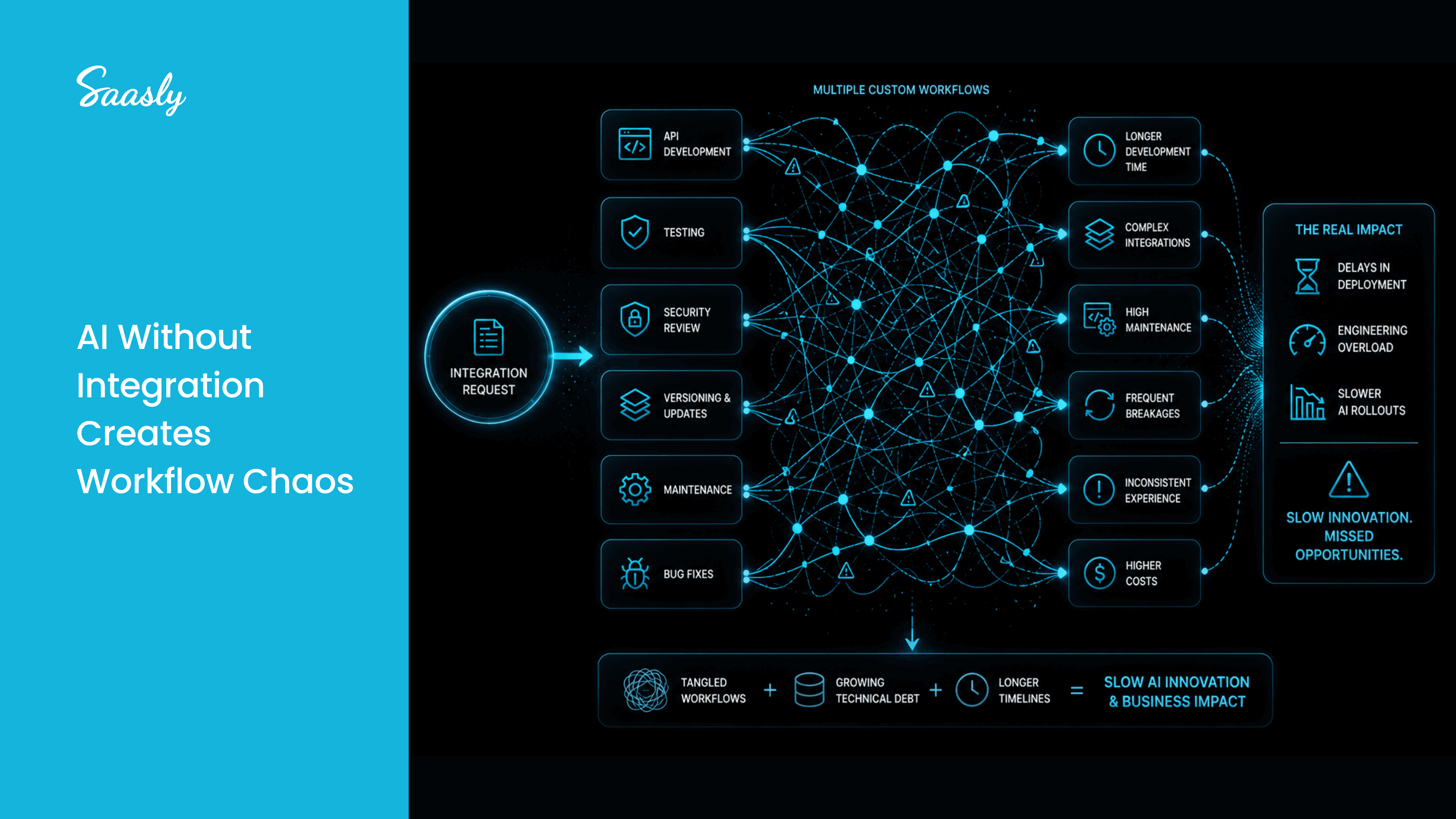
This often leads to:
- Growing engineering backlogs
- Increased technical debt
- Longer implementation timelines
- Delayed AI feature rollouts
- Slower enterprise onboarding
- Reduced capacity for product innovation
As enterprise demand continues to increase, relying solely on custom integration development becomes difficult to scale. AI innovation slows when engineering teams are constantly rebuilding the same integrations instead of advancing the core platform.
AI Agents Need Connected Business Systems
AI is only as effective as the data and systems it can access.
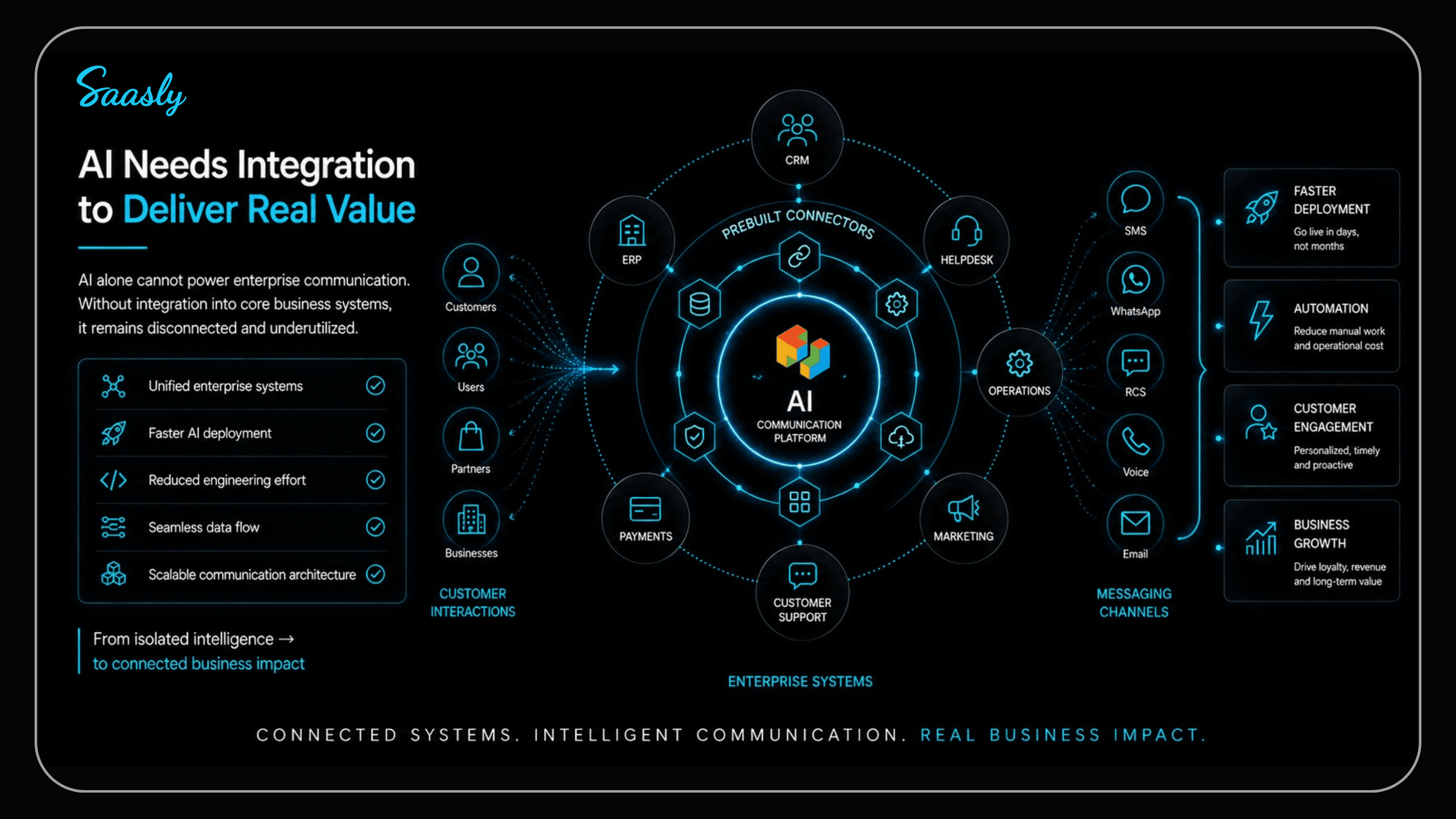
An AI agent can answer questions, recommend actions, or automate tasks, but without access to business data, its capabilities are limited. It cannot retrieve customer information, update CRM records, trigger workflows, or provide contextual responses unless it is connected to the systems that power daily business operations.
Modern enterprises rely on multiple business applications, including:
- CRM platforms (Salesforce, HubSpot, Microsoft Dynamics)
- Helpdesk platforms (Zendesk, Freshdesk)
- ERP systems
- Order and inventory management platforms
- Payment gateways
- Knowledge bases
- Calendar and scheduling applications
- Communication channels such as SMS, WhatsApp, RCS, Voice, and Email
Imagine an AI agent handling a customer support request. It identifies the customer's issue, checks the order status, verifies payment details, creates a support ticket, updates the CRM, and sends an RCS or WhatsApp notification—all within seconds.
This level of automation is only possible when AI can securely connect and communicate with multiple enterprise applications.
Without these integrations, AI becomes isolated intelligence. It may understand the customer's request but cannot take meaningful business actions.
Why Prebuilt Connectors Become a Competitive Advantage
As AI-powered communication becomes the new standard, enterprise customers expect faster implementations and seamless connectivity across their technology stack.
Building custom integrations for every project is no longer sustainable.
Prebuilt connectors offer a more scalable approach by providing reusable integration components that eliminate repetitive development while maintaining consistency across deployments.
Beyond accelerating implementation, prebuilt connectors deliver several long-term business advantages.
Reusable Architecture
Instead of recreating similar integrations for every customer, engineering teams can leverage standardized connector frameworks that support multiple enterprise deployments.
Consistent API Integrations
Standardized connectors improve API reliability, simplify testing, and reduce integration inconsistencies across projects.
Lower Maintenance Overhead
Maintaining one reusable connector is significantly more efficient than supporting dozens of customer-specific integrations, reducing long-term engineering effort.
Scalable Enterprise Growth
As customer demand grows, new deployments can be completed much faster because common integration patterns already exist.
Better Engineering Productivity
Engineering teams spend less time rebuilding integrations and more time improving AI capabilities, communication channels, and platform innovation.
Reduced Technical Debt
Reusable connectors simplify upgrades, API version management, and security improvements while minimizing duplicated code across projects.
Ultimately, prebuilt connectors enable organizations to scale enterprise implementations without continuously increasing engineering resources.
Where Saasly Lego Box Fits
As enterprise demand for AI-powered communication platforms continues to grow, many CPaaS providers are adopting reusable connector frameworks instead of building every integration from scratch.
This is where Saasly Lego Box fits naturally into the enterprise integration ecosystem.
Rather than replacing internal development teams, Lego Box provides a collection of prebuilt enterprise connectors that simplify connectivity between communication platforms and business applications.
Using reusable connector components, CPaaS providers can connect with CRM platforms, helpdesk solutions, ERP systems, marketing tools, and other enterprise applications while significantly reducing repetitive integration work.
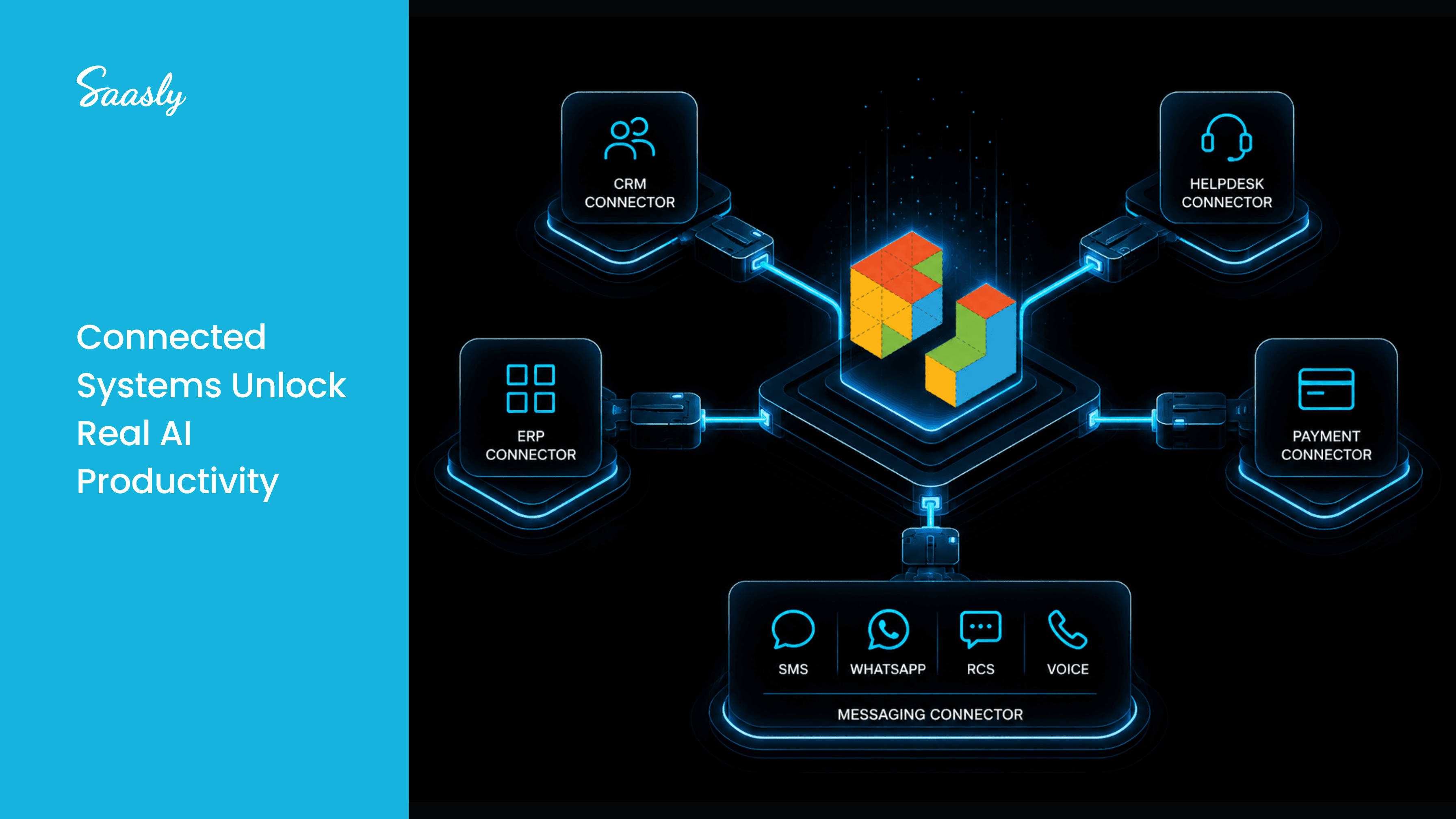
This allows engineering teams to focus on developing AI capabilities, improving communication services, and delivering product innovation instead of repeatedly solving the same integration challenges.
For organizations building AI-powered CPaaS platforms, reusable connector frameworks provide a strong foundation for delivering scalable enterprise deployments.
Conclusion
The CPaaS industry is entering a new phase where AI is becoming central to enterprise communication.
However, AI alone is not enough.
Enterprise customers no longer evaluate AI capabilities separately from integrations. They evaluate how quickly AI can connect with the business systems they already use, automate workflows, and deliver measurable business outcomes.
The platforms that succeed in 2026 will not simply offer the most advanced AI features. They will combine intelligent automation with scalable integration ecosystems that enable faster deployments, connected customer experiences, and continuous innovation.
Prebuilt connectors are no longer just a way to accelerate implementation. They are becoming a strategic foundation for the next generation of AI-powered CPaaS platforms.
Frequently Asked Questions
1. Why is AI changing the CPaaS industry?
AI enables CPaaS platforms to automate customer interactions, intelligent routing, workflow orchestration, and real-time decision-making, making communication platforms more efficient and scalable.
2. Why aren't messaging APIs alone enough for enterprise customers?
Enterprise organizations expect communication platforms to integrate with CRM, ERP, helpdesk, and business applications so AI can automate workflows using real-time business data.
3. What are prebuilt connectors?
Prebuilt connectors are reusable integration components that simplify connectivity between communication platforms and enterprise applications, reducing development effort and accelerating deployments.
4. How do prebuilt connectors benefit CPaaS providers?
They reduce repetitive engineering work, lower maintenance costs, improve deployment consistency, accelerate enterprise onboarding, reduce technical debt, and allow teams to focus on product innovation.
5. Why do AI agents require enterprise integrations?
AI agents need access to customer data and business systems to perform meaningful actions such as updating CRM records, triggering workflows, creating support tickets, and sending personalized communications.
6. How does Saasly Lego Box support AI-powered CPaaS platforms?
Saasly Lego Box provides reusable enterprise connectors that help CPaaS providers integrate with CRM, helpdesk, ERP, and other business applications more efficiently, enabling faster deployments and reducing repetitive integration development.