

Back
What Are Zoho Zia Agents? How AI Agents Work in Zoho Applications.

Bellarmine Joshi V
- November 23, 2026
7 min read

Introduction to Zia Agents
Artificial intelligence is moving beyond systems that simply generate responses. AI agents can interpret a goal, reason through a task, use configured tools, and take actions within an authorized environment. Zia Agents bring this agent-based approach into Zoho's business applications, helping organizations apply AI to practical workflows rather than using it only as a conversational assistant.
Depending on their configuration, agents can understand a request, retrieve relevant information, analyze context, select suitable tools, perform permitted actions, and escalate work when human judgment is needed.
Why Do We Need AI Agents in Zoho Products?
Traditional automation is effective when the process is predictable: for example, assigning a newly created ticket to a department, sending an email, and updating a field. It becomes less effective when a task requires interpreting language, considering past interactions, or combining information from several records.
Imagine a customer says, "The payment went through, but my subscription is still inactive. I have already contacted support twice." A rule-based workflow can detect the ticket, but understanding the underlying issue may require reviewing the conversation, customer details, and related records. An AI agent can be configured to gather that context and help determine the next step.
This distinction is central: automation follows known rules, while an AI agent can use context to work toward a defined objective. Agents do not have to replace existing workflows; they can complement them where fixed rules alone are insufficient.
Understanding Zia Agents and Their Role in Zoho
Zia Agents act as an intelligent execution layer between a user's business requirement and the applications or tools required to complete it.
A useful way to think about the difference is:
Traditional automation: Trigger -> Condition -> Predefined Action -> Result
AI Agent:
Goal -> Understand Context -> Reason -> Select Required Tools -> Execute Actions -> Evaluate Result -> Complete / Escalate
This does not mean that AI agents replace existing Zoho automation. Instead, they can complement workflows that are difficult to implement entirely through fixed rules.
For example, in Zoho Desk, an AI agent can be used for support-related processes such as generating responses, analyzing tickets, or documenting resolutions. Zoho Desk currently provides predefined Zia agents such as Support Specialist and Resolution Expert for specific support workflows.
The broader Zia Agents platform also allows organizations to create agents around their own business requirements rather than limiting them to predefined use cases. Zoho's Agent Store provides pre-built agents, while custom agents can be created when an existing agent does not meet a particular requirement.
How Zia Agents Work
At a high level, an AI agent receives a task or goal and determines how that goal can be accomplished using the information and capabilities available to it.
For example:
Goal: Help a support agent respond to a customer asking about a refund.
The agent may need to:
- Understand the customer's request.
- Read the ticket conversation.
- Search the organization's knowledge base.
- Retrieve relevant customer information.
- Determine whether the request satisfies the refund policy.
- Generate an appropriate response.
- Perform an action if the agent has been given the required permission.
The agent therefore needs more than an LLM or conversational interface. It needs context, knowledge, tools, connections, instructions, and appropriate permissions.
Zoho's Zia Agents documentation identifies components such as instructions, knowledge bases, tools/tool groups, and connections as important parts of configuring an agent.
A simplified architecture can be represented as:
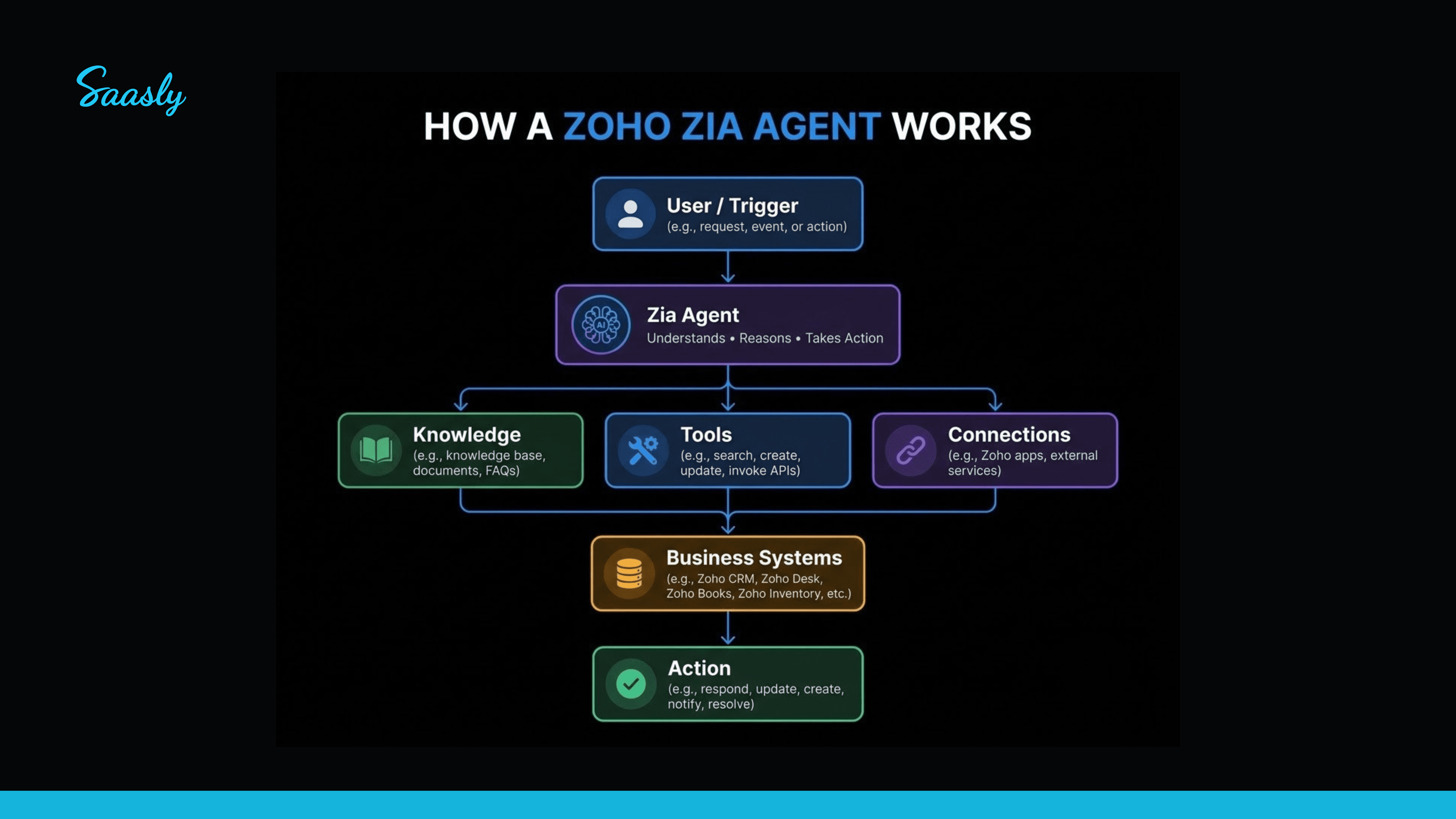
The key idea is that the agent doesn't need to have every piece of information internally. It can use the configured knowledge and tools to obtain the information required to complete the task.
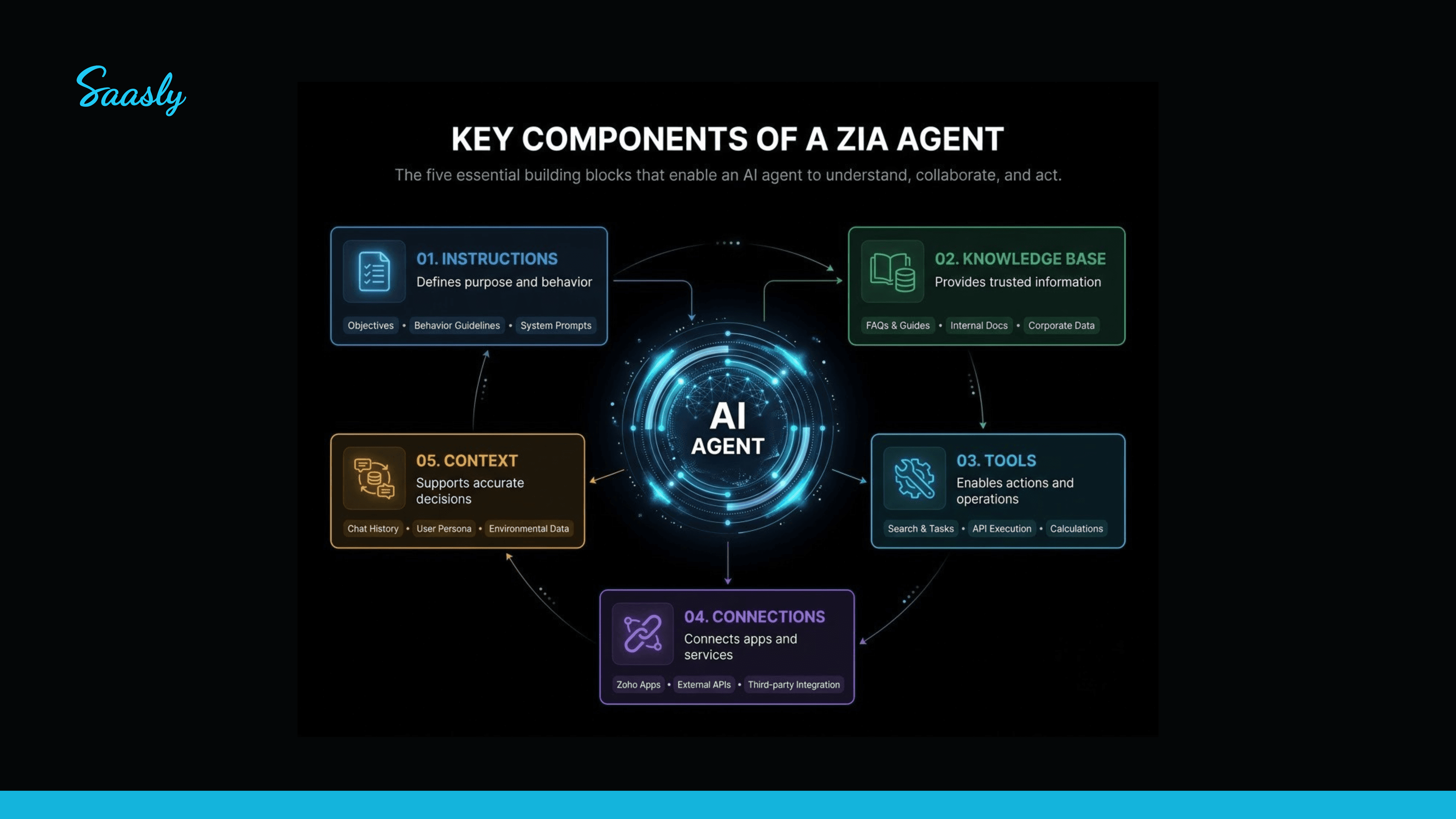
Key Components of a Zia Agent
A successful AI agent depends on more than just the underlying AI model. It needs to be provided with the right instructions, knowledge, capabilities, and access.
1. Instructions
Instructions define the agent's purpose and behavior.
For example:
"You are a customer support assistant. Analyze incoming tickets and provide responses based only on the organization's approved knowledge base."
Clear instructions help establish the boundaries of the agent.
2. Knowledge Base
The knowledge base provides the information the agent can refer to when solving a problem.
For a support agent, this could include:
- Product documentation
- FAQs
- Troubleshooting guides
- Policies
- Internal support documentation
Zoho's documentation describes the knowledge base as an important source of information that helps an agent perform its intended purpose.
3. Tools
Tools give the agent the ability to perform actions.
An agent may need tools to:
- Search records
- Retrieve ticket information
- Update records
- Create tasks
- Send notifications
- Invoke APIs
- Perform business operations
Without tools, an agent may understand what needs to be done but may not have the ability to actually perform the task.
4. Connections
Connections provide the required access to applications or external services.
This becomes particularly important when an agent needs to interact with Zoho applications or external systems.
5. Context
The agent also needs relevant context to make accurate decisions. The quality of the context supplied to the agent can have a significant impact on the quality of its output.
Conclusion
Zia Agents represent an important shift in how AI can be applied within business applications.
Traditional automation is excellent for predictable, rule-based processes. Generative AI improves how users interact with information. AI agents take the next step by combining reasoning, knowledge, tools, business context, and actions to accomplish specific goals.
The most important part of building an AI agent is therefore not the AI model itself. It is identifying the right business problem and designing the agent around that problem.
A well-designed agent should have:
- A clearly defined purpose
- Precise instructions
- Reliable knowledge
- Relevant tools
- Controlled access to business data
- Appropriate permissions
- Strong testing
- Clear escalation paths
With these principles, Zia Agents can become more than an AI chatbot—they can become a practical AI workforce embedded within Zoho's business applications, helping organizations automate complex processes while keeping humans involved where judgment and decision-making are required.
FAQs
1. What are AI agents in the Zoho ecosystem?
AI agents are intelligent systems that can understand business objectives, use available tools and knowledge, make decisions, and perform tasks across Zoho applications with appropriate permissions.
2. How are future AI agents different from today's AI assistants?
Traditional AI assistants primarily respond to user requests. Future AI agents are expected to become more proactive, context-aware, adaptive, and collaborative, allowing them to identify problems, coordinate with other agents, and take appropriate actions with less manual intervention.
3. What are multi-agent systems in Zoho?
Multi-agent systems involve multiple specialized AI agents working together. For example, a support agent could coordinate with finance, product, or CRM agents to resolve a customer issue that requires information from different business functions.
4. Will AI agents be able to work across multiple Zoho applications?
The long-term direction is toward more connected agents that can operate across applications and business functions. This could allow agents to combine customer, support, sales, billing, and product context when handling complex business processes.
5. Can AI agents continuously improve business workflows?
Future agents could analyze the results of completed workflows and identify recurring problems or inefficiencies. They could recommend improvements to processes, knowledge bases, or automation while allowing organizations to approve significant changes.