

Back
Integration ROI for CPaaS Platforms: Measuring the Revenue Impact of Faster Onboarding

Admin
- June 4, 2026
7 min read

Introduction
Most CPaaS companies track messaging volume, customer acquisition costs, and platform usage.
Far fewer measure the financial impact of one of their most important growth levers:
Integration speed.
When a new enterprise customer signs a contract, revenue generation does not begin immediately. The customer must first connect your platform with their CRM, helpdesk, marketing systems, identity providers, and internal workflows.
This onboarding phase often takes weeks or even months.
During this period:
- Revenue realization is delayed
- Product adoption slows
- Engineering costs increase
- Expansion opportunities are postponed
The longer onboarding takes, the longer it takes customers to achieve value from your platform.
For CPaaS providers, this creates a hidden revenue leak.
This article explores how to calculate Integration ROI, measure the business impact of faster onboarding, and understand why prebuilt connectors have become a strategic investment for modern CPaaS companies.
Why Integration Speed Matters More Than Ever
Enterprise customers increasingly expect software platforms to integrate seamlessly with their existing technology stack.
A typical enterprise deployment may require:
- Salesforce integration
- HubSpot integration
- Zendesk integration
- Freshdesk integration
- ERP connectivity
- Identity and access management integration
- Internal workflow automation
Each integration requirement adds complexity to implementation.
According to a recent Moxo onboarding study, 56% of organizations experience onboarding delays, while only 34% rate their onboarding process as highly efficient. These delays directly affect customer activation and time-to-value.
For CPaaS providers, onboarding delays often result in:
- Delayed revenue recognition
- Longer implementation cycles
- Higher onboarding costs
- Reduced customer satisfaction
- Increased pressure on engineering teams
The question is no longer whether integrations matter.
The question is:
How much revenue are slow integrations costing your business?
Understanding Integration ROI
Integration ROI measures the business value generated by reducing onboarding effort and accelerating customer activation.
A simplified formula looks like this:
Integration ROI = (Revenue Gained + Cost Savings – Integration Investment) ÷ Integration Investment × 100
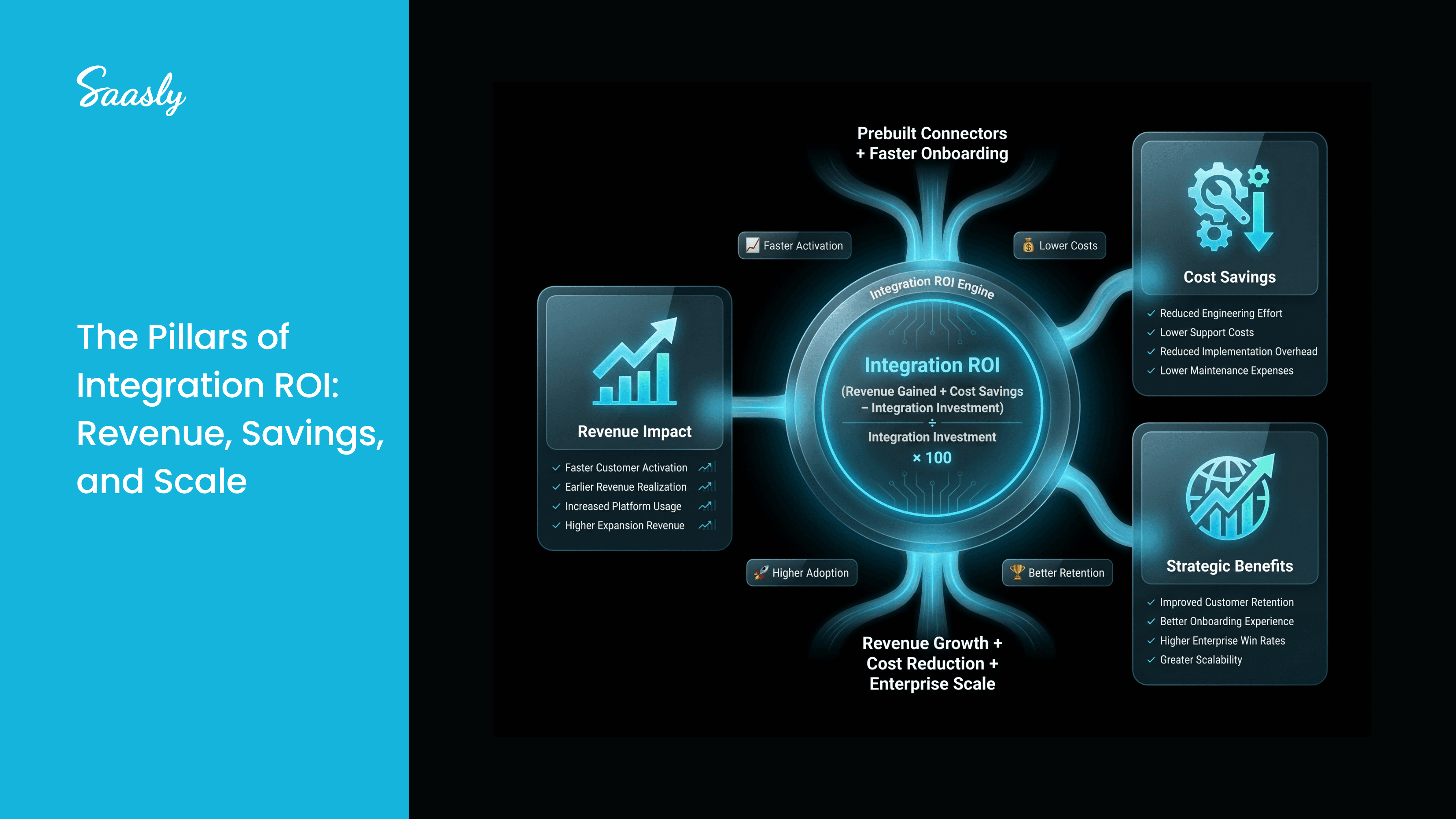
The calculation includes both direct and indirect benefits.
Direct Revenue Impact
- Faster customer activation
- Earlier subscription revenue realization
- Increased platform usage
- Higher expansion revenue
Cost Savings
- Reduced engineering effort
- Lower support costs
- Less implementation overhead
- Reduced maintenance expenses
Strategic Benefits
- Improved customer retention
- Better onboarding experience
- Increased enterprise win rates
- Greater scalability
The Hidden Cost of Slow Onboarding
Many CPaaS companies underestimate the financial consequences of implementation delays.
Let's look at a common scenario.
Example
A CPaaS company signs:
- 50 enterprise customers annually
- Average Annual Contract Value (ACV): $30,000
Total Annual Revenue: $1.5 Million
Now assume onboarding takes 12 weeks instead of 4 weeks.
This creates an additional delay of 8 weeks before customers become fully operational.
Revenue realization is postponed. Customer value realization is postponed. Expansion opportunities are postponed.
Across dozens of customers, the cumulative impact becomes significant.
Even a modest reduction in onboarding time can unlock hundreds of thousands of dollars in earlier realized revenue.
Faster Onboarding Creates Faster Revenue
The relationship is simple:
Faster Onboarding → Faster Customer Activation → Faster Product Adoption → Faster Revenue Generation → Higher Lifetime Value
Enterprise software research consistently shows that customers who achieve value quickly are more likely to expand usage and renew contracts.
For CPaaS companies, activation often depends on successful integrations.
If integrations take months, customers cannot fully use:
- WhatsApp messaging
- RCS campaigns
- SMS automation
- Voice workflows
- Omnichannel communication journeys
The platform may technically be purchased, but it is not delivering business value.
Measuring the Revenue Impact of Faster Onboarding
Let's compare two onboarding scenarios.
Scenario A: Custom Integrations
- Customer onboarding time: 12 weeks
- Average annual contract value: $30,000
- New customers per year: 50
- Implementation cost per customer: $8,000
- Engineering hours per deployment: 120+
Result:
- Slow activation
- High engineering dependency
- Delayed revenue realization
- Limited scalability
Scenario B: Prebuilt Connector Ecosystem
- Customer onboarding time: 4 weeks
- Average annual contract value: $30,000
- New customers per year: 50
- Implementation cost per customer: $2,500
- Engineering hours per deployment: 30–40
Result:
- Faster activation
- Lower onboarding costs
- Faster time-to-revenue
- Improved customer satisfaction
Reducing onboarding from 12 weeks to 4 weeks delivers:
- 67% Faster Customer Activation
- Lower Implementation Costs
- Higher Deployment Capacity
- Increased Revenue Velocity
The impact compounds as customer volume grows.
Engineering ROI: The Often Ignored Metric
Revenue is only one side of the equation.
Engineering efficiency is equally important.
Many CPaaS companies experience integration backlogs because developers spend significant time building customer-specific integrations.
Typical requests include:
- Salesforce
- HubSpot
- Zoho CRM
- Freshdesk
- Zendesk
- Microsoft Dynamics
Each custom project consumes resources that could otherwise be invested in:
- Product innovation
- AI features
- Messaging capabilities
- Platform reliability
- New channel support
When integrations become reusable connectors, engineering effort shifts from repetitive implementation work to strategic product development.
This creates long-term ROI beyond onboarding acceleration.
The Business Case for Prebuilt Connectors
Prebuilt connectors provide one of the highest-leverage investments available to CPaaS providers.
Benefits include:
Reduced Time-to-Market — Customers go live faster.
Lower Engineering Costs — Less custom development.
Faster Customer Activation — Value is delivered sooner.
Improved Sales Conversations — Sales teams can confidently promise faster deployment.
Greater Enterprise Scalability — More customers can be onboarded without expanding implementation teams.
Reduced Integration Backlogs — Engineering teams focus on innovation rather than repetitive projects.
How to Calculate Your Own Integration ROI
Use this framework.
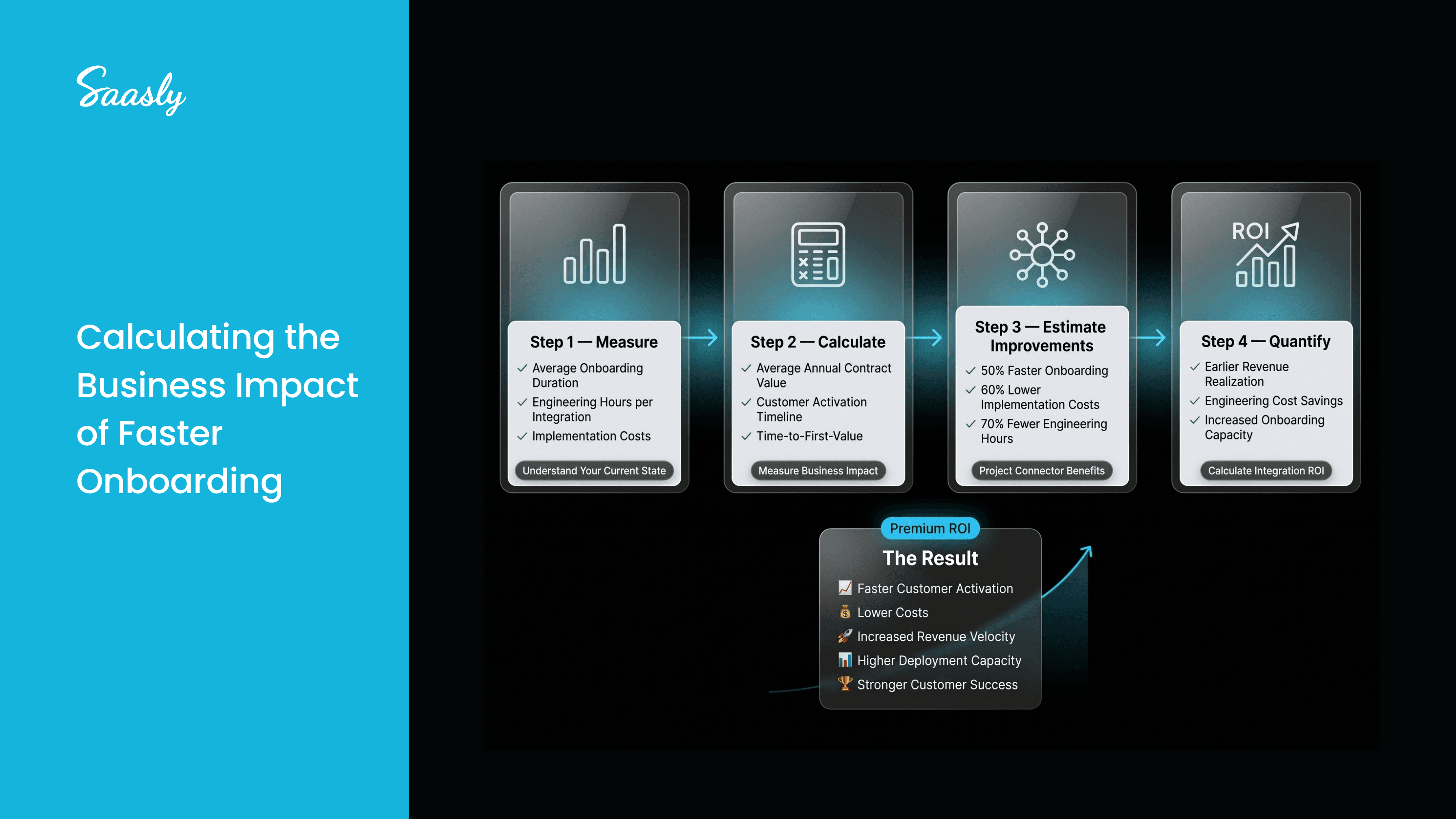
Step 1 — Measure
- Average onboarding duration
- Engineering hours per integration
- Implementation costs
Step 2 — Calculate
- Average annual contract value
- Customer activation timeline
- Time-to-first-value
Step 3 — Estimate improvements from prebuilt connectors
For example:
- 50% onboarding reduction
- 60% implementation cost reduction
- 70% fewer engineering hours
Step 4 — Quantify
- Earlier revenue realization
- Engineering cost savings
- Increased onboarding capacity
The result is your integration ROI.
Many CPaaS providers discover that the business value of faster onboarding far exceeds the initial investment in connector development.
Why Connector Ecosystems Are Becoming a Competitive Advantage
Enterprise buyers increasingly evaluate platforms based on:
- Available integrations
- Deployment timelines
- Ease of implementation
- Ecosystem maturity
Features alone are no longer enough.
Customers want solutions that fit seamlessly into their existing technology stack.
A mature connector ecosystem helps CPaaS providers:
- Win enterprise deals faster
- Reduce onboarding friction
- Accelerate customer success
- Improve retention
- Expand partner opportunities
In many cases, integrations become a decisive factor in vendor selection.
How Lego Box Helps CPaaS Platforms Maximize Integration ROI
Saasly's Lego Box is designed to help CPaaS providers accelerate onboarding and improve integration ROI through a growing ecosystem of prebuilt connectors.
Instead of repeatedly building custom integrations, teams can leverage reusable connectors for:
- CRM platforms
- Helpdesk systems
- Messaging platforms
- Enterprise applications
- Workflow automation tools
This enables organizations to:
- Reduce onboarding timelines
- Lower engineering costs
- Improve customer activation rates
- Scale deployments efficiently
- Increase revenue velocity
The result is measurable business impact and stronger long-term growth.
Conclusion
For many CPaaS providers, the biggest obstacle to growth is not customer acquisition.
It is customer activation.
Every week spent building integrations delays revenue, increases costs, and slows product adoption.
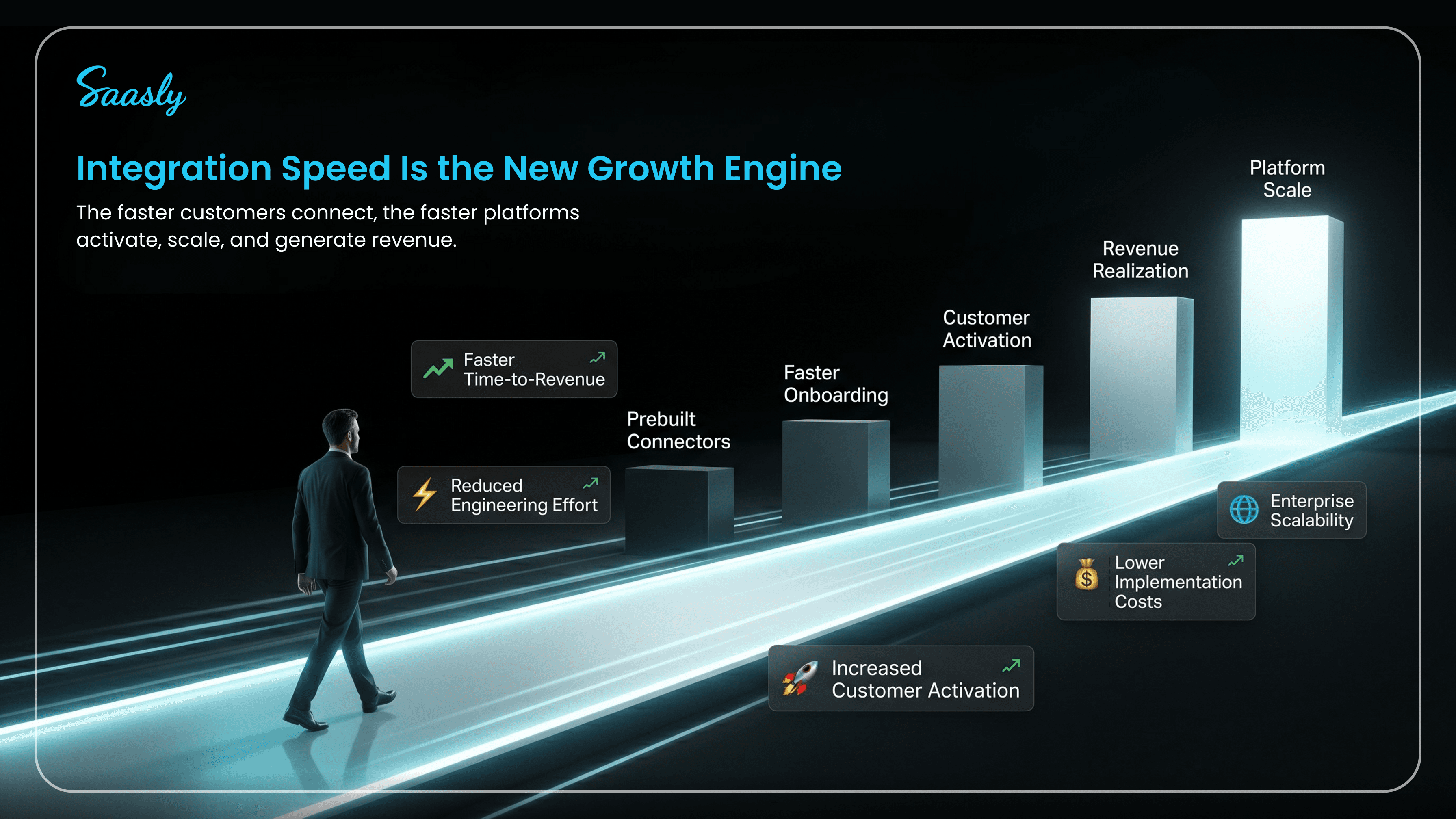
Measuring Integration ROI helps organizations understand the true financial impact of onboarding speed.
The companies that invest in connector ecosystems, reusable integrations, and onboarding acceleration will gain a significant competitive advantage in the years ahead.
Because in today's CPaaS market, faster onboarding isn't just an operational improvement.
It's a revenue strategy.
Ready to Scale Faster?
Discover how the Saasly Lego Box helps CPaaS platforms accelerate onboarding, reduce implementation costs, and maximize integration ROI.
Contact Us: Contact Saasly