

Back
Beyond APIs: How AI and MCP Are Making CPaaS Platforms Agent-Ready

Arun
- August 4, 2026
5 min read

Introduction
For years, CPaaS providers have focused on building powerful APIs and SDKs that developers can use to integrate SMS, WhatsApp, Voice, and other communication capabilities.
But the way software interacts with these platforms is changing.
AI agents are becoming a new type of user.
Instead of a developer manually reading API documentation and building every integration, AI agents can interact with defined tools through the Model Context Protocol (MCP).
For CPaaS providers, this raises an important question:
Are your communication APIs ready for AI agents to use?
From API-Ready to Agent-Ready CPaaS
Traditional CPaaS integration follows a familiar model:
Developer → API → CPaaS → Communication Channel
The developer understands the documentation, selects an endpoint, provides the required inputs, and builds the workflow.
With AI agents, the interaction can look different:
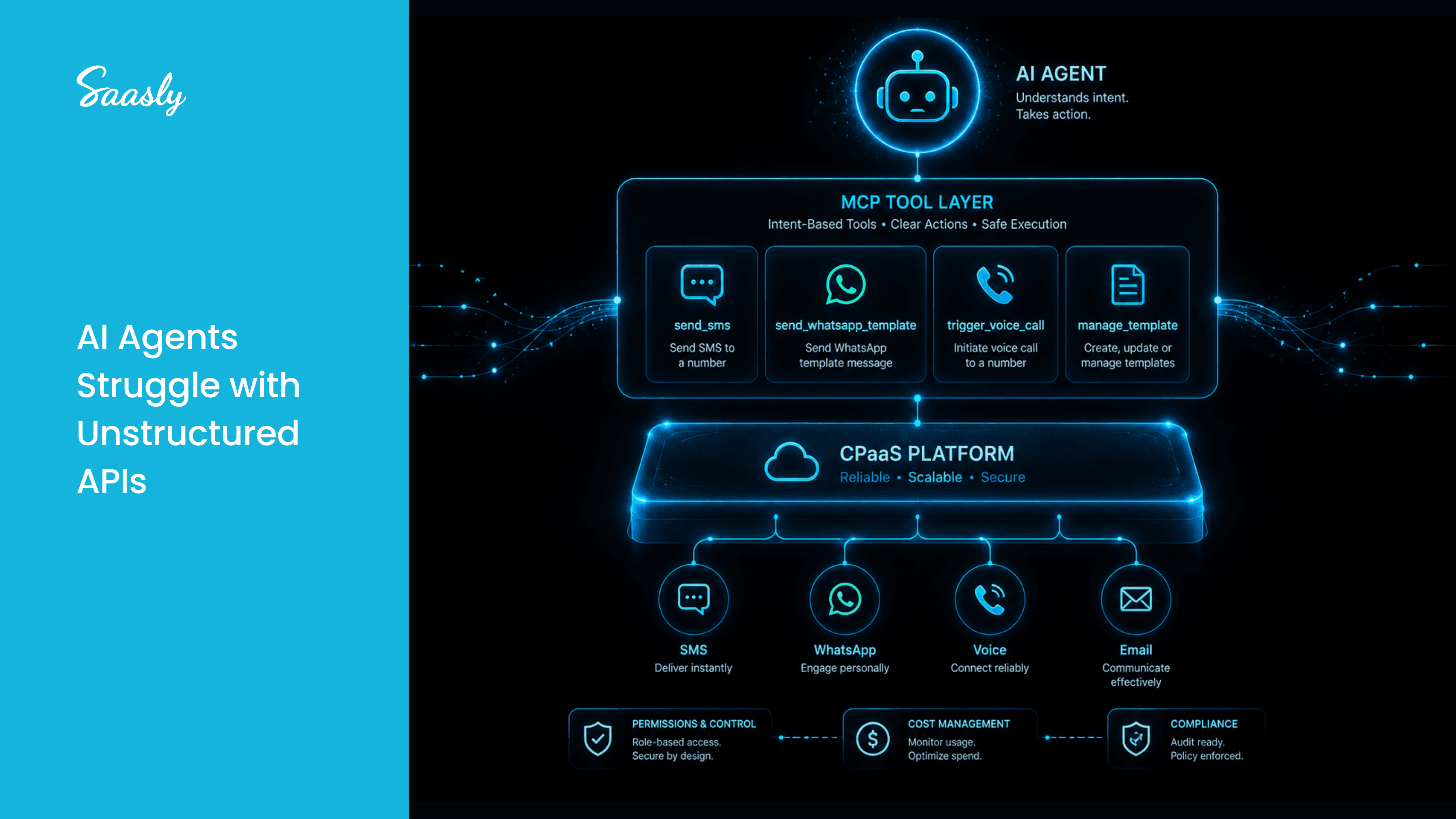
AI Agent → MCP Tool → CPaaS → Communication Channel
The key difference is how capabilities are presented.
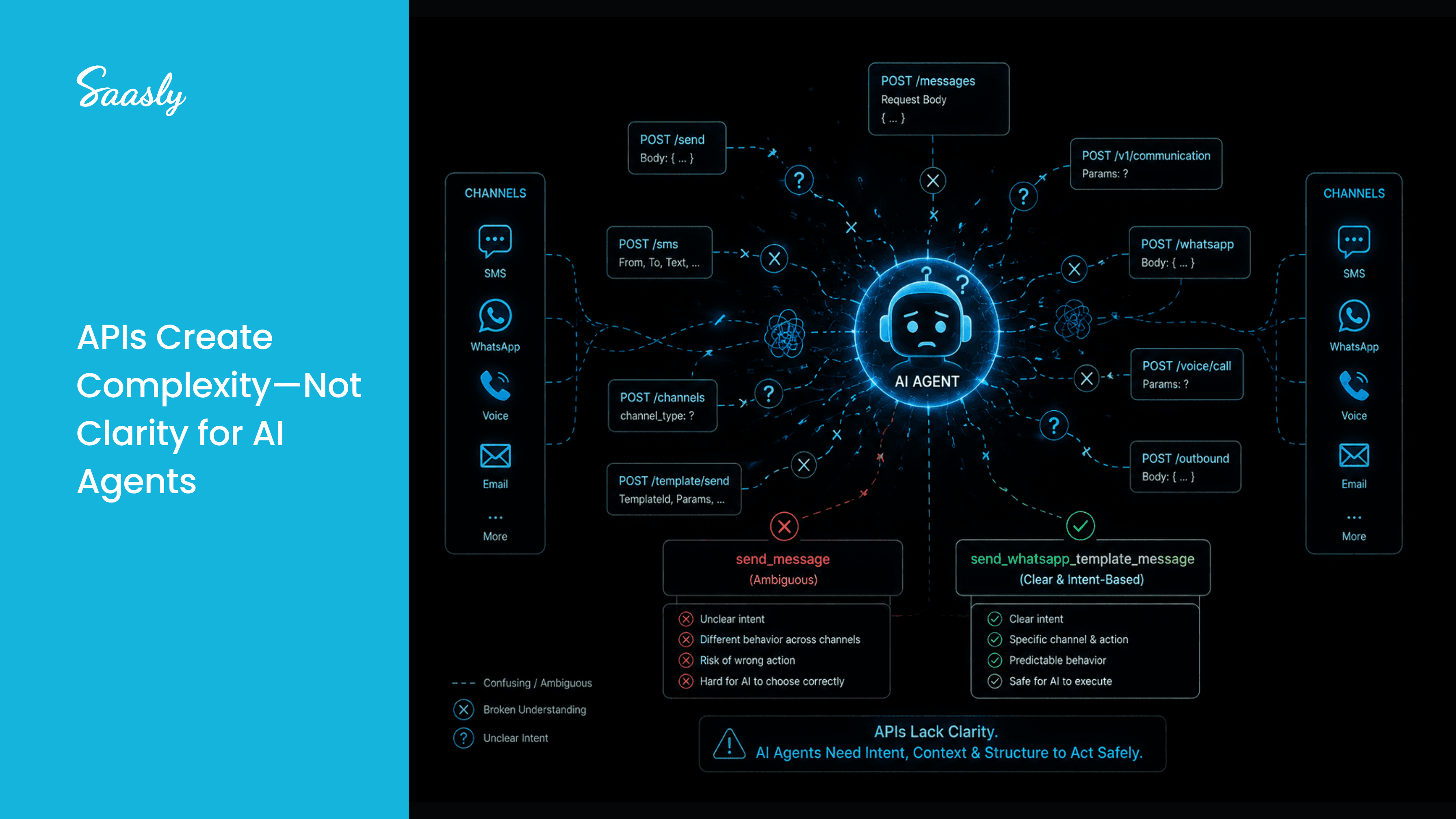
An API endpoint might expose:
POST /messages
A tool designed for an AI agent could instead be:
send_whatsapp_template_message
The second approach gives the agent clearer information about the action it can perform.
This is where MCP for CPaaS becomes important.
What Is MCP for CPaaS?
The Model Context Protocol (MCP) provides a structured way for AI systems to interact with external tools and capabilities.
For CPaaS providers, an MCP server can expose communication functions as defined tools that AI agents can discover and use.
This doesn't mean traditional APIs are becoming irrelevant.
APIs and SDKs will continue to be important for developers.
Instead, MCP creates an additional integration surface for AI agents.
The shift is from simply asking:
“Can developers integrate our API?”
to also asking:
“Can AI agents understand and use our communication capabilities?”
Why CPaaS Needs a Different Approach
CPaaS isn't just about retrieving information.
Most important CPaaS capabilities are action-oriented.
An AI agent could potentially:
- Send an SMS
- Send a WhatsApp template
- Trigger a voice call
- Provision a phone number
- Manage a communication template
These actions can have real-world consequences involving cost, delivery, customer experience, and compliance.
That's why simply exposing existing API endpoints through an MCP server isn't enough.
The tools need to clearly communicate what the agent is allowed to do and what action each capability represents.
Design Tools Around Intent
This is one of the most important considerations when building an agent-ready CPaaS platform.
Consider two tools:
Generic:
send_message
Specific:
send_whatsapp_template_message
The second tool provides much clearer intent.
This becomes especially important when a CPaaS platform supports multiple channels such as SMS, WhatsApp, Voice, and Email.
Each channel can have different rules and behaviors. A generic tool that changes behavior depending on hidden parameters can create ambiguity for an AI agent.
For CPaaS providers, the goal should be to expose capabilities in a way that an AI agent can understand clearly and execute appropriately.
MCP Doesn't Replace a Strong API
There is one important point to remember:
MCP cannot fix a weak CPaaS foundation.
If an API has unclear behavior or poor access controls, exposing it through MCP does not automatically solve those problems.
Instead, preparing for AI agents gives providers an opportunity to examine their existing:
- API design
- Tool definitions
- Integration architecture
- Permission controls
- Communication workflows
A strong foundation makes it easier to build a reliable AI-agent integration layer.
Where Saasly Fits
As CPaaS platforms move toward AI-driven workflows, integration architecture becomes increasingly important.
Saasly, Spritle's CPaaS and marketplace application development unit, works on CPaaS integrations and enterprise application connectivity.
Spritle is also an Official Registered Partner in the Claude Partner Network, with 10+ Claude Certified Architects across its team.
This combination of CPaaS integration experience and AI-focused architecture capabilities supports providers exploring MCP integration, AI agent integration, and agent-ready CPaaS platforms.
The goal isn't to replace traditional APIs.
It is to help communication platforms evolve their integration architecture so that their existing capabilities can work effectively with emerging AI-driven workflows.
Conclusion
CPaaS has evolved from simple communication APIs into broader communication platforms.
Now, AI agents are creating another shift.
MCP provides a way for AI agents to interact with clearly defined communication capabilities, giving CPaaS providers a new integration surface to consider.
For providers, becoming agent-ready isn't simply about adding MCP.
It's about making communication capabilities clear, controlled, and usable for AI-driven workflows.
The next generation of CPaaS won't just be developer-ready. It will need to be ready for AI agents too.
Frequently Asked Questions
What is MCP for CPaaS?
MCP for CPaaS provides a structured way for AI agents to interact with communication capabilities exposed by a CPaaS platform through defined tools.
Does MCP replace CPaaS APIs?
No. APIs and SDKs remain important for traditional developer integrations. MCP provides an additional integration approach for AI-agent workflows.
Why do CPaaS providers need AI agent integration?
AI agents are creating a new way for software to interact with platforms. AI agent integration can allow CPaaS capabilities to become part of automated workflows.
Why is tool design important for CPaaS MCP integration?
CPaaS platforms perform real-world actions. Clearly defined tools help AI agents understand which communication action they are being asked to perform.
How does Saasly support AI and CPaaS?
Saasly combines CPaaS integration experience with AI-focused architecture capabilities, supported by 10+ Claude Certified Architects within Spritle.